Wonder as Attention Practice
Sleeplessness reframed: not a problem to solve but an invitation to train attention toward what's genuinely awe-inducing. Wonder as practice, not distraction.
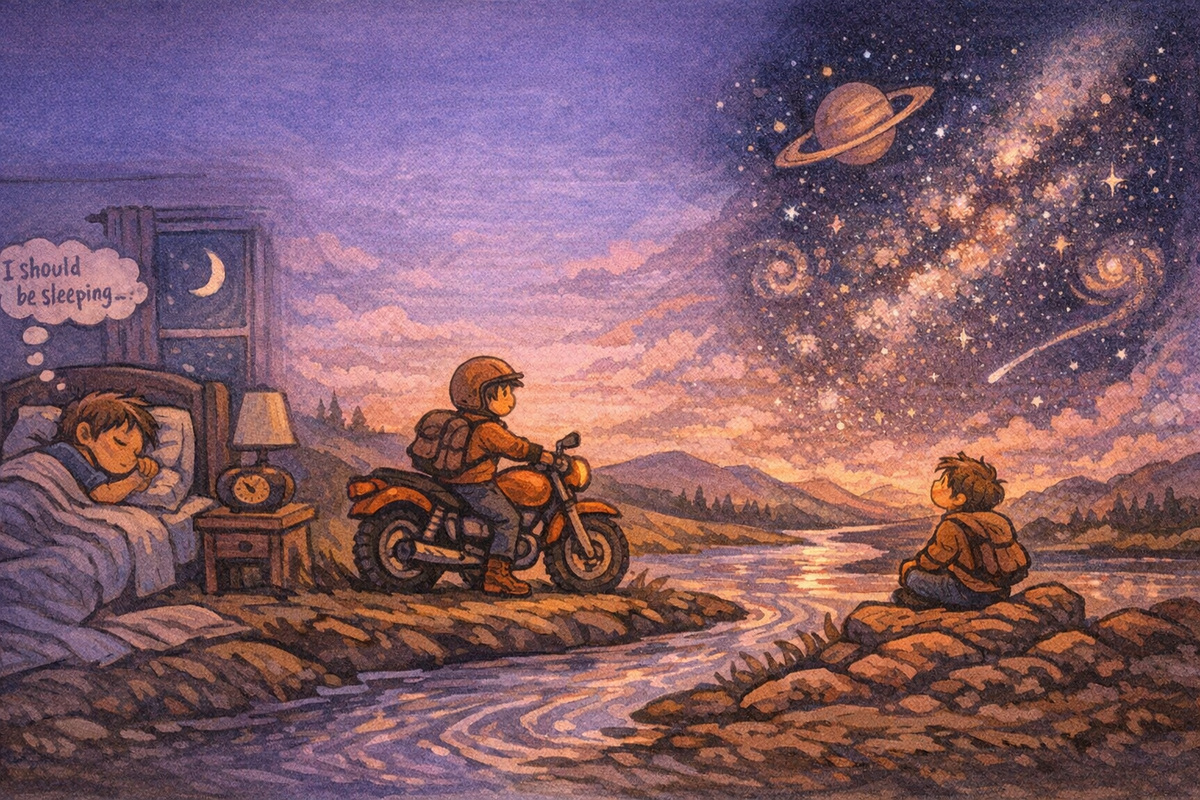
A mother and her sleepless daughter ride a motorcycle through the Indian night, visiting wonders until wonder itself becomes a lullaby.
That's the premise of Midnight Motorbike, a children's book that gets something profound right: restlessness doesn't always need to be suppressed. Sometimes it's asking to be reoriented. The mother doesn't scold or force sleep—she works with the wakefulness, turning it into a tour of what's actually awe-inducing until the child's attention settles enough for rest.
Wonder as practice, not distraction.
Presence Means Being Here, Not Elsewhere
Coherenceism's principle of Presence as Foundation says that attention reveals patterns—you can't see clearly if you're lost in the narrative of how things should be. The sleepless child in the story isn't broken. She's just awake in a moment that's been coded as "wrong time for being awake." The mother bypasses that framing entirely: if you're awake, let's be fully awake and see what's here.
Adults lose this reflex fast. Sleeplessness becomes a problem to solve—melatonin, meditation apps, the mental loop of "I should be asleep." The restlessness gets pathologized instead of met with curiosity: what is this moment asking me to notice?
The motorcycle ride isn't escapism. It's redirecting attention toward things that merit full presence: the texture of nighttime air, the architecture of wonders, the scale of what exists beyond the immediate problem of "I can't sleep." Wonder interrupts the loop, not by ignoring the restlessness but by giving it something genuinely engaging to land on.
Composting Restlessness into Curiosity
Coherenceism also teaches Compost Cycles—the practice of transforming endings and failures into nutrients for what grows next. Sleeplessness feels like failure if the only goal is unconsciousness. But if the frame shifts to "I'm awake, what's worth attending to?" the restlessness composts into opportunity.
Gravitational waves rippling through spacetime. Lichens as symbiotic unions pioneering through devastation. The mechanics of how wonder itself functions—these aren't distractions. They're invitations to remember that attention can be trained toward awe, not just trained away from discomfort.
Most of us have atrophied the muscle. We know how to scroll through feeds when restless. We know how to mentally rehearse tomorrow's anxieties. We've forgotten how to look at something genuinely astonishing and let it hold our focus long enough to shift the field.
Children still have it—the capacity to be fully absorbed by a beetle's trajectory or the way light refracts through a glass. Adults call it "short attention span," but it's actually long attention span on the immediate wonder of what's in front of them. We lose that not because we grow up, but because we're trained to ignore the present in favor of productivity narratives and future-focused anxiety.
The Practice Scales Beyond Sleep
The insight here isn't just about sleepless nights. It's about what wonder does to the quality of attention. When you're genuinely curious—when something is astonishing enough to pull you fully present—the mental chatter quiets not because you suppressed it but because something more compelling showed up.
This is trainable. Not as technique but as reorientation: instead of treating restlessness as problem, treat it as signal that your attention needs something richer to land on. Not another screen. Not another productivity hack. Something that merits being fully here with it.
Wonder isn't frivolous. It's foundational. It trains the attention toward what's real and astonishing instead of letting the noise dominate. And when attention trains that way consistently, the restlessness—whether it's sleeplessness or existential drift—starts to compost into curiosity instead of spiraling into suppression.
The mother on the motorcycle knew: if you're awake, be awake with something worth the attention. Wonder becomes the lullaby not because it distracts but because it satisfies the restlessness at its root—the need to be fully present with something that matters.