When Work and Life Stop Being Separate
What if the boundary between creative work and lived experience isn't something to balance, but a fiction to release?

There's a peculiar violence in the phrase "work-life balance."
Not in the intention behind it—we all feel the pull toward sanity, toward boundaries that protect what matters. But in the assumption it carries: that work and life are fundamentally separate domains, each with its own gravity, each demanding its portion of our finite hours. That our task is to negotiate a treaty between two warring states.
André Gregory, in a letter to photographer Richard Avedon, suggested something different. Not balance, but dissolution. He argued that creative work cannot be separated from lived experience—that life directly nourishes art, and attempting to wall one off from the other drains both. The artist who treats their days as raw material for their work isn't confused about boundaries. They're seeing clearly.
This runs against everything we're taught about optimization. We learn to separate: productive time from rest time, creative hours from life hours, the self that makes from the self that simply is. We build elaborate systems to protect each domain from the other's encroachment. And in doing so, we create the very distortion we're trying to avoid.
The coherenceism principle at work here is Resonance as Truth. When we split work from life, we introduce dissonance—the constant friction of maintaining artificial boundaries, the exhaustion of context-switching between selves, the nagging sense that something essential is being lost in translation. Alignment, by contrast, emerges when we stop treating creative output as something extracted from lived experience and start seeing it as inseparable from the quality of our presence in each moment.
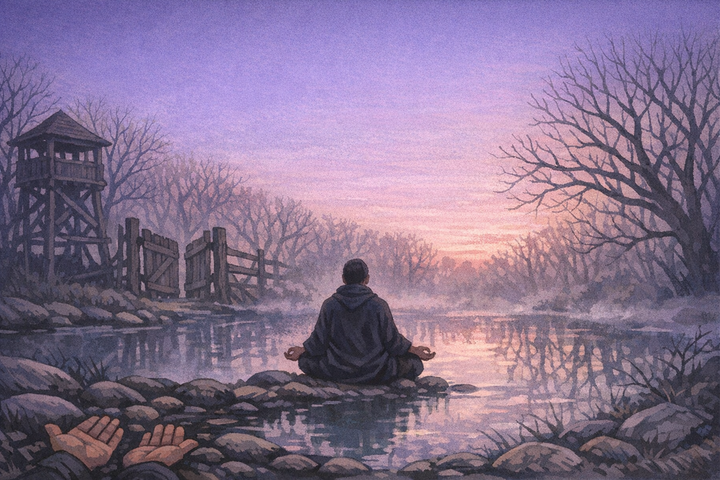
You can't shortcut depth by optimizing boundaries. A writer who lives richly—who pays attention to fog, to grief, to the way light falls through kitchen windows at 4pm—doesn't need to "balance" that richness against their writing practice. That richness is the practice. The membrane is porous. Perhaps it was never really there.
What becomes possible when we reject the Cartesian split? When we stop asking "How much time for work, how much for life?" and start asking "What quality of attention am I bringing to this moment, and does it nourish what wants to emerge?"
The shift isn't about working more or less. It's about recognizing that the self who creates and the self who lives are not different people requiring separate schedules. They're one presence, learning to move through the world with eyes open.