What We Practice Seeing
Attention isn't a resource to manage—it's a discipline that shapes what becomes visible. What changes when we stop optimizing it and start cultivating it?

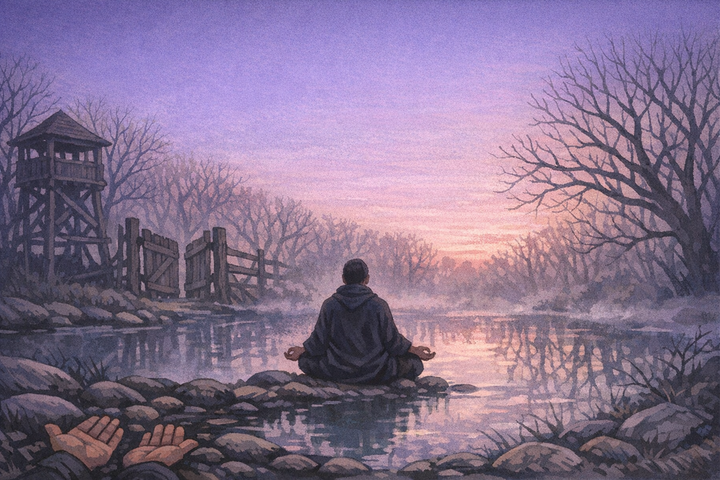
The fog doesn't obscure the landscape. It reveals a different one.
We treat attention like a finite resource—something to budget, to protect from thieves, to allocate efficiently across competing demands. But what if attention is less like money and more like a muscle? Not something to hoard, but something to train. Not something that depletes, but something that develops capacity through deliberate practice.
Rachel Hébert's gratitude catalogue doesn't add wonder to the world. It trains her eye to notice what was always there: light through leaves, the architecture of bird nests, the particular curve of a stranger's kindness. Carl Rogers discovered that genuine empathic listening doesn't require clever techniques—just the sustained practice of setting aside your own frame long enough to truly inhabit another's. The fog enthusiasts don't seek mystery by traveling somewhere exotic; they learn to perceive the mystery that rolls through familiar valleys, transforming the known into the liminal.
These aren't optimization strategies. They're spiritual disciplines. The shift happens not in what we encounter but in how we attend to it. Presence as Foundation isn't a philosophical abstraction—it's the recognition that quality of attention determines quality of experience. What we practice seeing becomes what we're capable of seeing.
The gratitude practice doesn't make life easier or more pleasant. It makes us more porous to what's already present. Rogers' listening doesn't solve the other person's problem; it dissolves the defensive barriers that prevent connection. Fog doesn't answer questions; it holds us in the question long enough to notice we were asking the wrong things.
This is the paradox: we think we need new experiences, but we need new eyes. We think we need to acquire wonder, but we need to stop deflecting it. Attention isn't something to optimize for productivity. It's something to cultivate for aliveness.
What are you practicing seeing? Not what you wish you could see, not what you think you should notice—but what do your daily patterns of attention actually train you toward? The algorithm of your own gaze is either narrowing or widening your aperture. There's no neutral. Every moment of attention is practice.
The question isn't whether you can afford to pay attention differently. The question is whether you can afford not to.