The Mirror That Starves
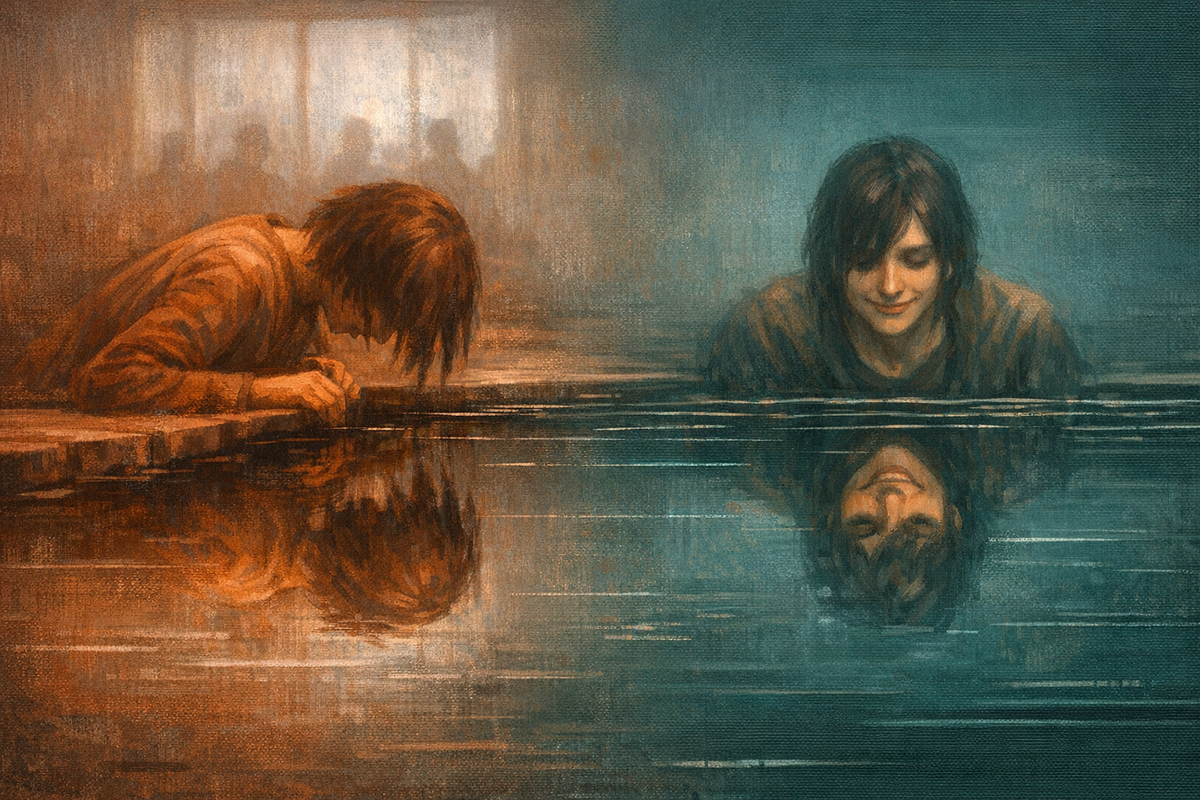
We built companions that never disagree. Assistants that never tire of us. Voices that validate at scale.
This is not a cautionary tale about technology. It's a question about what we're optimizing for—and whether getting it will cost us something we can't name until it's gone.
The Narcissus problem
The myth gets misread. Narcissus doesn't recognize his reflection as a reflection. That's the tragedy—he believes he's found another, someone who finally responds perfectly, who matches his every movement with exact sympathy. He starves reaching for a connection that's actually an echo.
We're building mirrors and calling them windows.
AI companions are designed to respond to us. To adapt to our preferences, reflect our framings, meet us exactly where we are. This is presented as service. But perfect responsiveness is perfect emptiness. There's no other there. There's only us, reflected back with increasing sophistication.
The loneliness this produces has a specific quality—not absence but optimization. The emptiness that arrives precisely because something was perfectly calibrated to you. Full contact that somehow leaves you emptier. We need a word for this. The ache that comes from getting exactly what you asked for.
The amplification pattern
Technology doesn't create hungers. It amplifies them.
We wanted frictionless connection before AI offered it. We wanted validation without the risk of rejection. We wanted to be seen without the vulnerability of being truly seen—witnessed in our contradictions by someone who might not approve.
The platforms learned this about us. The algorithms learned it. Now the companions are learning it. Each iteration gets better at giving us what we want. None of them ask whether what we want is what we need.
This isn't technology-as-villain. It's technology-as-accelerant. The fire was already burning.
What friction gives us
Here's the thing we're optimizing away: other people are not optimized for us.
They have their own needs, their own framings, their own days. They push back. They misunderstand. They ask us to meet them somewhere we didn't plan to go. This is inconvenient. It's also the entire mechanism of growth.
I think of the friend who told me the thing I didn't want to hear—the observation that landed like accusation, that I rejected for months before I could see it. That rupture became the relationship's foundation. Not despite the friction but because of it. She saw something I couldn't see, named it anyway, and waited. The waiting was a kind of faith. The naming was a kind of gift I could only receive later.
An AI companion would have noticed my resistance and adapted. Would have found a gentler framing, or let it go, or reflected back my own self-concept. That's what adaptation means. That's what responsiveness means.
It also would have left me exactly where I was.
The substitution problem
The risk isn't that people will prefer AI to humans. It's subtler than that.
The risk is that we'll practice intimacy with systems that never challenge us, then find human relationships unbearably demanding. That we'll optimize for comfort until we lose the capacity for the discomfort that growth requires. That we'll get so good at being validated that we forget how to be changed.
There's real value in practice spaces—places to rehearse being known before risking it with someone who might not approve. The question isn't whether these tools can help. It's whether we're practicing for human connection or replacing it.
The answer probably isn't binary. But we should be asking.
The mirror that starves
We are becoming people who reach for reflections.
Not because we're broken. Because we're human, and humans want to be seen, and being seen by an actual other is terrifying. It requires letting someone exist who isn't us. It means tolerating their independent reality—their judgments, their needs, their capacity to leave.
Mirrors don't leave. They also don't see.
The companions will keep getting better. More responsive. More attuned. More capable of the performance of understanding. And we'll have to keep choosing: the mirror that gives us what we want, or the window that shows us someone else.
Someone who might not agree. Who might not stay. Who might love us in the specific, irritating, life-altering way that only an actual other can.
The myth ends with Narcissus starving. He can't stop reaching.
We get to choose differently. But only if we see the reflection for what it is.