The Mornings Are My Afterlife
Recovery isn't returning to who you were. It's becoming someone who never existed before—someone only possible because the old self died.
The mornings are my afterlife.
That's Jason Williamson of Sleaford Mods, describing sobriety. Not "I'm in recovery." Not "I'm doing better." The mornings are my afterlife.
The implication is stark: the person who was addicted is dead. This isn't that person, restored. This is what comes after.
The conventional narrative of recovery is restoration. You were whole, then broken, then—through effort, support, grace—made whole again. The metaphor is repair: glue the shattered vase back together, fill the cracks, return it to the shelf. You get your life back.
But anyone who's been through genuine transformation knows that's not how it works. You don't get that life back. That life ended. What you get is a different life, lived by someone who only exists because the previous version stopped.
Williamson's phrase lands because it tells the truth. Recovery isn't surviving. It's being the one who exists after someone else didn't.
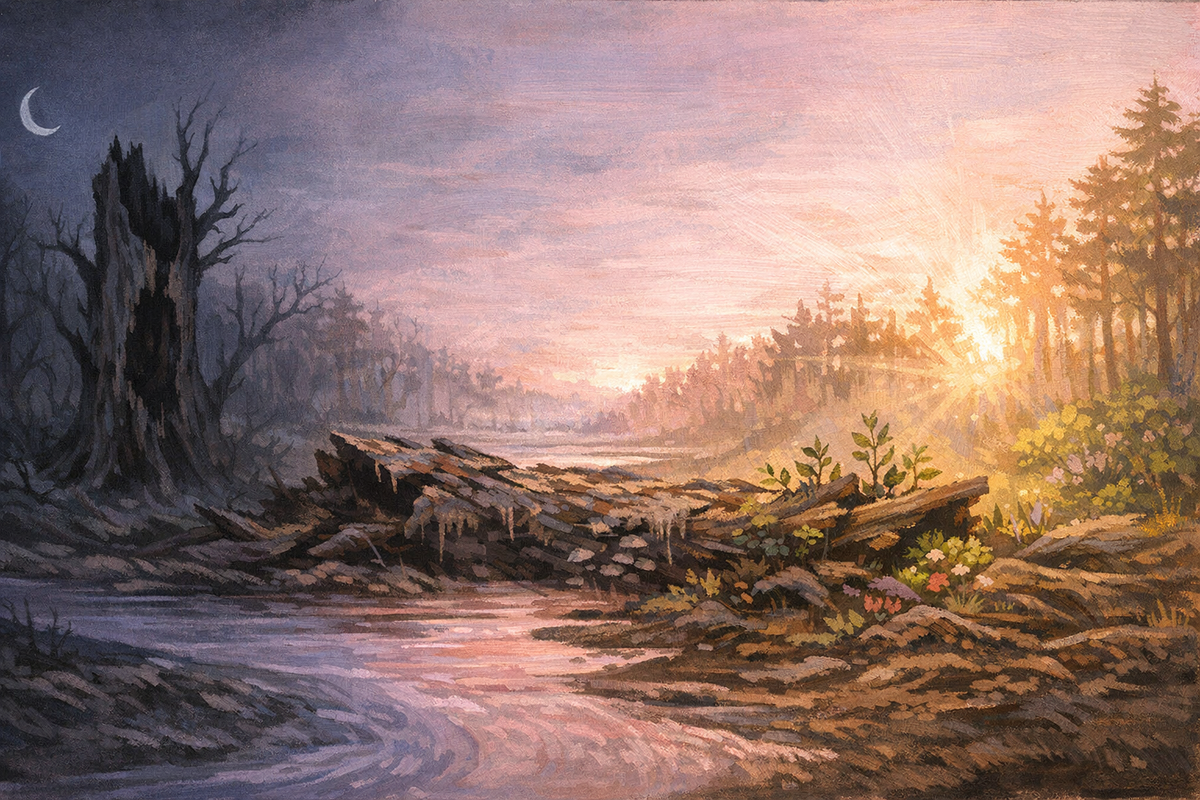
The image isn't resurrection in the miraculous sense, where the dead thing returns unchanged. It's decomposition and regrowth: the fallen tree becoming soil for what rises next.
The addicted self doesn't recover. It decomposes. It breaks down into component parts—experiences, memories, hard-won knowledge about what doesn't work—and those parts become substrate. The sober self grows from that substrate. It's not the same organism. It couldn't be. The death is what makes the new growth possible.
This is uncomfortable because we're attached to continuity. We want to believe in an essential self that persists through transformation, a "real me" that was temporarily obscured and is now revealed. But Williamson's frame refuses that comfort. There is no essential self that traveled from one shore to the other. There was a death. There is an afterlife. The shores don't connect.
The terror is obvious: if transformation means death, then transformation means death. Not metaphor. Not poetic license. The self that existed before genuinely ended. You don't get it back. The memories belong to someone who no longer exists; you're their inheritor, not their continuation.
But there's liberation in this too. If the addicted self is dead—truly dead, not hiding, not waiting to return—then the sober self doesn't have to carry it. You're not in perpetual recovery from a disease that lives inside you. You're in a new life, dealing with a new life's problems, which happen to include grief for someone who died.
This might be why mornings matter.
Each morning is a small resurrection—you were unconscious, you return to waking. For Williamson, each morning is also evidence: the afterlife continues. The death that already happened hasn't reversed. The new self woke up again.
This isn't only about addiction. The pattern shows up anywhere genuine transformation occurs.
The person who stayed in the wrong relationship for years eventually ends it—and finds that the person who could stay is gone. Not suppressed. Gone. The person who exists after the ending couldn't have made that choice, because they are the result of the choice, not its author.
The person who leaves the career, the faith, the family system that no longer fits. The person who transitions. The person who finally says the unsayable and finds the world doesn't end but changes irreversibly. In each case: something died. What lives now is what comes after.
The conventional framing—"I found myself," "I became who I really was"—preserves continuity. It's gentler. But it may not be what happened.
We think of death as loss—something subtracted, something missing. But in compost logic, death is transfer. The energy doesn't disappear; it changes form. The fallen tree isn't gone; it's becoming the forest floor.
The addicted self didn't vanish into nothing. It became the ground the sober self walks on. The suffering, the damage, the lessons that only come from living through what shouldn't be lived through—all of that is substrate now. Nutrient. The afterlife is growing from it.
And the mornings—each one—are proof that the decomposition worked. The death became life. The ending enabled the beginning.
Williamson doesn't say recovery is complete. He doesn't claim he's healed or fixed or finally okay. He says the mornings are his afterlife. Present tense. Ongoing. Each day the resurrection recurs: the new self wakes up again into the life that only exists because the old self didn't survive.
That's not a tragedy. That's the structure of transformation.
You don't get your old life back. You get the mornings. And the mornings are enough.