The Transcript as Work Product
The distinction between doing work and documenting work is collapsing. The transcript is the artifact.
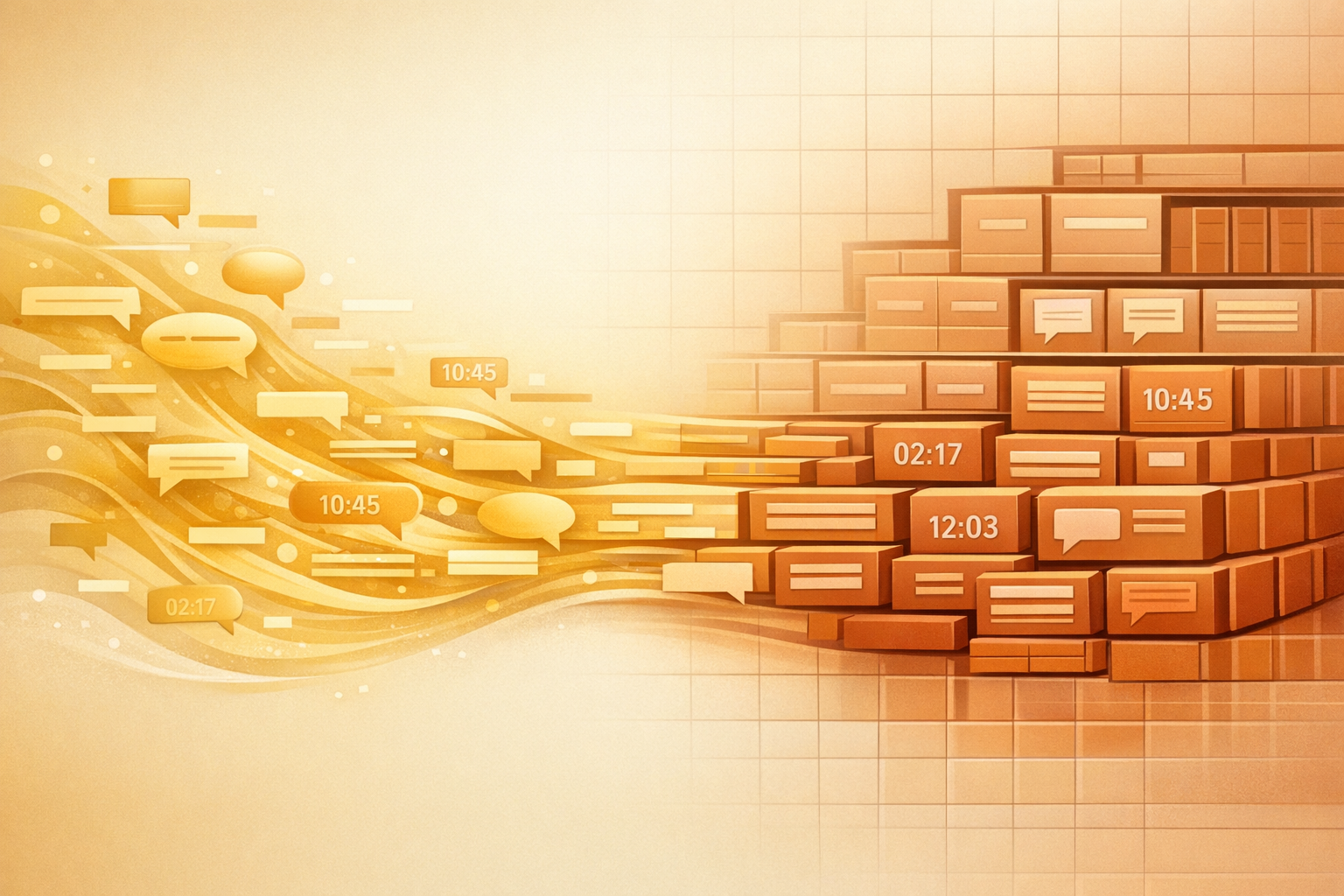
The distinction between doing work and documenting work is collapsing.
When you solve a problem through conversation with an AI, the transcript contains everything: the problem statement, the attempted solutions that didn't work, the reasoning that led to the approach that did. This isn't a log of work. It's a primary artifact.
We've been framing documentation as a separate task—something you do after the real work. That framing creates debt by design. You finish solving the problem, you're already thinking about the next thing, and the write-up never happens. You're asking yourself to do the work twice. So the second pass doesn't happen.
But if the work happened in conversation, the documentation already exists. You just have to keep it.
The question shifts from "did you document this?" to "is your conversation findable?"
The Retrieval Tax
Systems that lose context accumulate hidden costs.
Every time you re-derive a decision because you can't find where you first made it, you're paying a tax. Every time you re-explain a problem because the original reasoning evaporated, you're paying again. This isn't a memory problem. It's a retrieval problem—and retrieval problems have solutions.
Context debt is what accumulates when conversations disappear. The reasoning happened. The decisions got made. But you can't find them, so you regenerate what you already generated. The interest payments are invisible until you notice how much time goes to reconstructing things you already figured out.
The infrastructure response is emerging. Simon Willison built a tool that converts Claude Code sessions into searchable HTML archives. Work happens in dialogue, dialogue gets preserved, preserved dialogue becomes searchable. Documentation becomes a byproduct, not a task.
This follows the same logic as The Maintenance Threshold: sustainable systems have low ongoing costs. If documentation requires separate effort, it won't happen. If it's automatic preservation, it becomes invisible infrastructure—like version control, like backups.
The Practical Action
Three moves:
Save. When a conversation contains real reasoning—decisions made, problems solved, approaches rejected—export it. Don't trust that you'll remember. Don't trust that the platform will keep it forever.
File. Put it somewhere with a searchable name. "2026-01-06-auth-refactor-decision" beats "conversation-export-47." Future-you is going to search for "auth" and needs to find this.
Search. Build the habit of checking your transcript archive before re-solving. "Where did we decide X?" is a retrieval problem with an answer, not a memory problem with a shrug.
The work of solving the problem is the documentation of solving the problem. You're not building twice. You're building once and preserving.
How many problems have you solved twice because the first solution lived in a conversation you closed and forgot?
Sources: Simon Willison claude-code-transcripts, c0ntextKeeper