The Slow Disaster as Dominant Form
Our institutions are optimized for emergencies that announce themselves—the earthquake, the attack, the market crash. Events that cross a threshold, trigger detection, demand response. The UN Security Council convenes. States of emergency get declared.
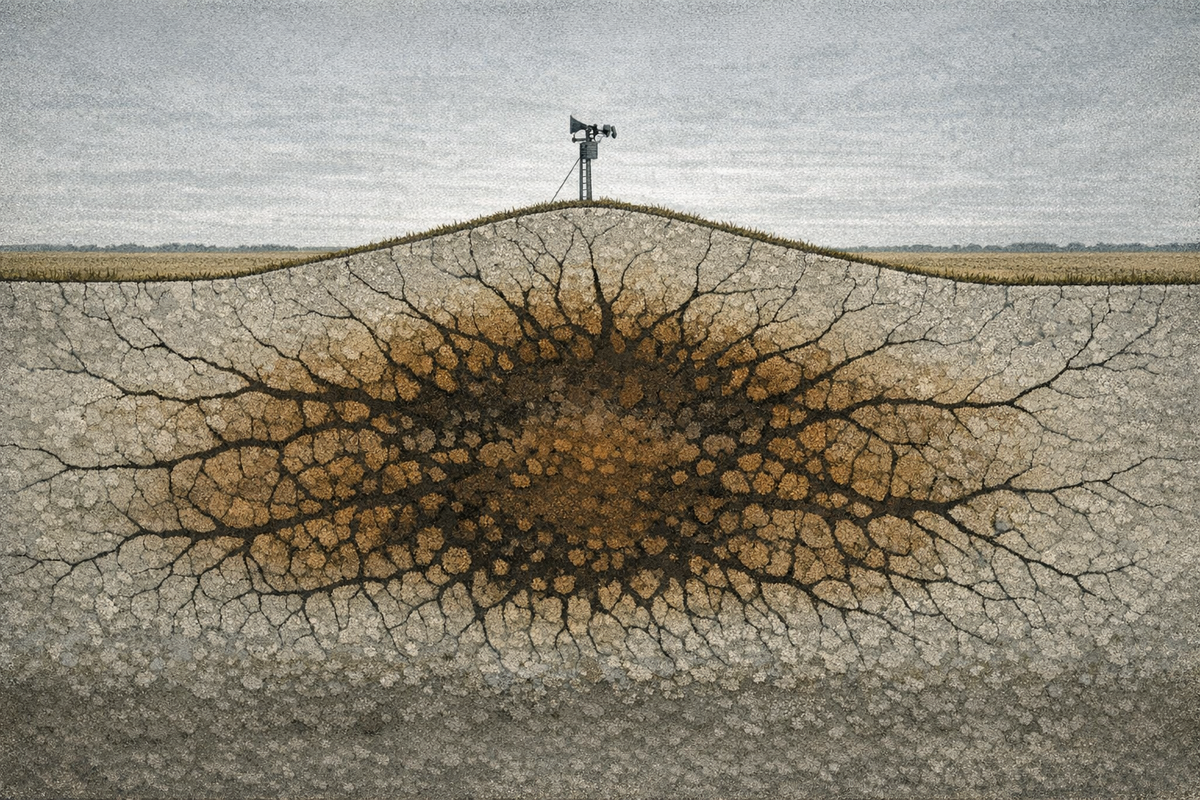
But the dominant disaster form of our era never crosses that threshold. Each day is only marginally worse than yesterday. The gradient is too shallow to register as signal.
The mismatch isn't just about speed—it's about what kind of thing registers as threat at all. Response systems assume a line will be crossed that triggers detection. Slow disasters don't cross lines. They redraw them, gradually, until the original boundary is no longer visible.
Consider the levees. Hurricane Katrina didn't break them—decades of deferred maintenance did. The failure accumulated at roughly 7% compound annually, invisible to any system designed for events rather than trajectories. By the time the acute disaster arrived, the slow disaster had already determined the outcome. The storm was the revelation, not the cause.
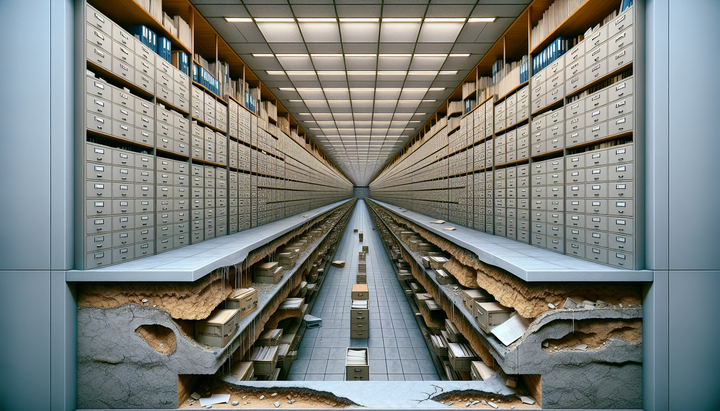
This pattern repeats across domains. Risk embedded in built environments through decades of planning decisions, each defensible in isolation, catastrophic in aggregate. Decision-making capacity decaying in parallel with physical infrastructure. The institutions that might respond are themselves subject to the same compound neglect.
We face a perceptual problem masquerading as a resource problem.
The question isn't primarily about money or political will. It's about what our systems can even perceive as requiring response. We have fire departments because fire presents as acute—visible, bounded, demanding immediate action. What's the equivalent for compound decay? For the kind of failure that accumulates rather than arrives?
The historical pattern is clarifying: civilizations rarely collapse from a single identifiable cause. They erode through slow-moving processes that individually seem manageable. Roman infrastructure didn't fail dramatically; it degraded incrementally until the maintenance knowledge itself was lost. The acute crises that appear in the historical record are typically consequences of slow disasters, not the disasters themselves.
What would institutions built for slow disaster actually look like? Not emergency responders, but gradient monitors. Not threshold-triggered, but trajectory-sensitive. Not designed for the crisis that announces itself, but for the one that never does.
We remain optimized for yesterday's dominant failure mode. The emergencies that killed our ancestors declared themselves. The ones that will define our era arrive the way water damage arrives—already there, by the time you see the stain.
Sources: Diplomatic Courier, Phys.org infrastructure research, Pew Charitable Trusts