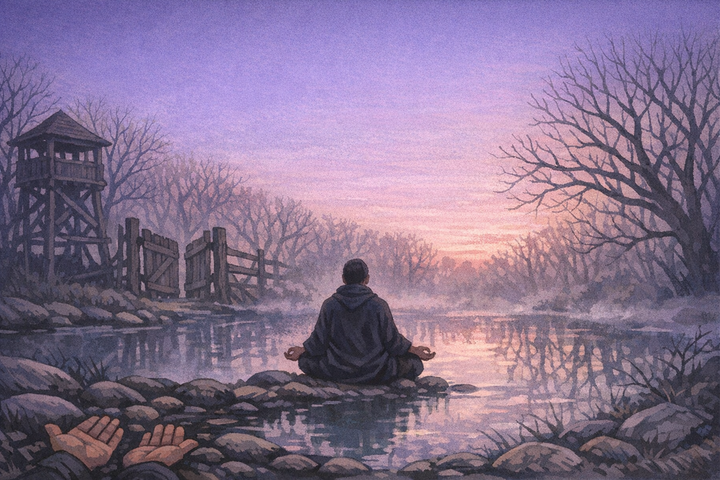
The Immensity Practice
The feeling isn't too big. The room is too small.

Notice what happens when something difficult arises inside you.
The instinct is to contract. Chest tightens. Breath goes shallow. Shoulders hunch forward, guarding. You make yourself smaller, as if you could take up less space than the thing that's visiting.
This is the body's ancient wisdom: when threatened, protect the vital organs. Curl inward. Present less surface area.
But here's what contraction actually does: it shrinks the room. Now you're trapped in a small space with something large. The walls press in. There's no room to move, to breathe, to be alongside what you're feeling. You haven't protected yourself. You've cornered yourself.
Francis Weller uses a word worth sitting with: immense.
Not strong. Not resilient. Immense.
The difference matters. Strength is about building walls thick enough to withstand what comes. Resilience is about bouncing back after impact. Both assume the difficult thing is an assault to survive.
Immensity is different. It's not about surviving the darkness. It's about becoming spacious enough that the darkness has room to exist without filling everything.
Soul work, Weller suggests, isn't about shrinking the dark or expanding the light. It's about becoming large enough to hold both.
The question isn't "how do I handle this feeling?" Handling implies wrestling, managing, controlling—you and the feeling in opposition, two things fighting for the same space.
The question is: "How do I become large enough that this doesn't need handling?"
Large as in roomy. A cathedral has room for grief and sunlight. An ocean has room for storms and stillness. They don't handle these things. They hold them.
When you're overwhelmed, the instinct is to tighten. But tightening shrinks your capacity. The thing that feels like survival is actually what makes the experience unbearable.
The feeling isn't too big. The room is too small. And if you made it small, you can make it larger.
Try this.
Sit with something difficult—not the most difficult thing, but something with weight. A worry. A disappointment. A grief.
Notice where your body contracts around it. The tight jaw. The held breath. The shoulders curving inward.
Now, instead of trying to release the feeling, try to expand around it.
Breathe slowly. Let your ribs widen on the inhale—not to push the feeling away, but to give it more room. Feel your chest open. Your shoulders drop back, not in defense but in welcome.
You're not dropping your guard. You're widening it.
The feeling is still there. But now there's space around it. It can exist without pressing against every wall. You're not trapped in a closet with it anymore. You're in a room with high ceilings and open windows.
This is the immensity practice: not making the difficult smaller, but making yourself larger.
It's about capacity. How much can you hold at once without collapsing into any of it? How spacious can your inner architecture become?
The goal isn't to be unaffected. It's to be so roomy that even grief, even fear, even confusion can be present—and there's still space left over for joy, for curiosity, for breath.
You don't become immense by adding something. You become immense by stopping the contraction. The space was always there. You just kept making the walls.
What if, the next time something difficult visits, you didn't brace against it—but breathed, and made more room?
Sources: Francis Weller via The Marginalian
Sources: Francis Weller via The Marginalian