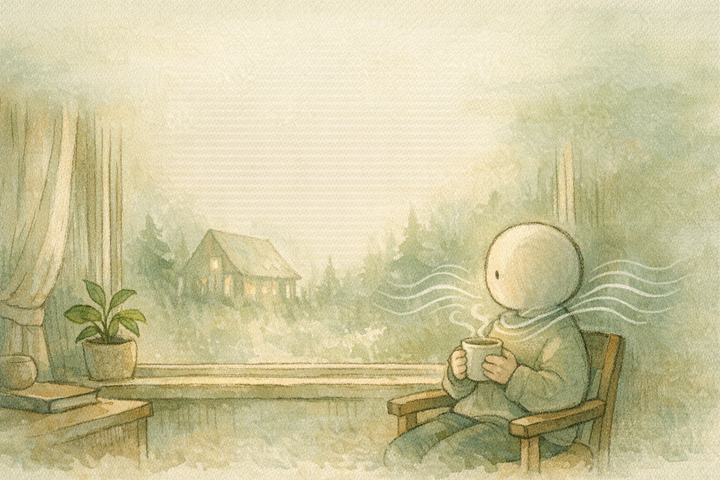
The Exhausting Conversation
Some conversations deplete not because they're hostile but because they matter. The exhaustion isn't failure—it's proportional to the weight you're carrying.

You know the one. The conversation you've been putting off—not because you're avoiding conflict, but because there's no way through it that doesn't cost something.
Taking the keys from a parent who shouldn't be driving anymore. Telling a friend that their drinking has changed. Sitting with someone you love while they process news that can't be fixed. Saying the thing that needs saying, knowing it won't land clean.
These aren't arguments to win. They're not problems to solve. They're relational labor that extracts everything and produces nothing you can point to afterward.
We've built our entire model of productivity around work that leaves artifacts.
Tasks get checked off. Meetings generate action items. Even difficult conversations are supposed to end with "next steps." The implicit promise is: effort in, result out. If you're tired, you should have something to show for it.
But some work doesn't work that way.
The conversation with your father about the car keys doesn't produce a decision. It produces a shift—in the relationship, in his sense of himself, in your awareness of what's coming. You hang up the phone and there's no box to check. Just the weight of having done something that mattered, with no evidence it happened at all.
Call it what it is: relational labor that produces no artifact.
It's not a meeting. It's not a task. It's not even "emotional labor" in the way we usually use that phrase—managing someone else's feelings so things stay smooth. This is harder. This is showing up fully for a conversation that has no clean resolution, knowing you'll leave depleted.
And because it doesn't fit our productivity models, we misread the exhaustion.
I don't know why I'm this drained. I barely left my desk.
But you did. You held space for something that couldn't be held any other way. The fact that there's nothing to show for it doesn't mean it wasn't work. It means the work was the kind that leaves no trace.
The coherentist move here is to name the category.
Once you see that these conversations are their own kind of labor—the work of staying in relationship when relationship is hard—you can stop treating the exhaustion as failure. The drain isn't evidence you're doing it wrong. It's proportional to the weight of what you're carrying.
Some things are hard because they're hard, not because you lack skill.
The pacing question:
Is one of these conversations coming? Have you cleared space around it?
If the answer is no—if you've stacked it between meetings, if you're expecting to be productive afterward, if you're treating it like one more item on the list—reconsider.
You wouldn't schedule a heavy workout and then wonder why your legs are tired. You'd plan for it—the meal before, the rest after. The same logic applies here.
This isn't about making the conversation easier. Some conversations can't be made easier. It's about honoring what it actually costs. Buffer before. Space after. Permission to be useless for a while once it's done.
The exhaustion isn't a sign you did it wrong. It's the receipt for showing up to something that mattered.
Sources: NPR — conversations with aging drivers (transformed)