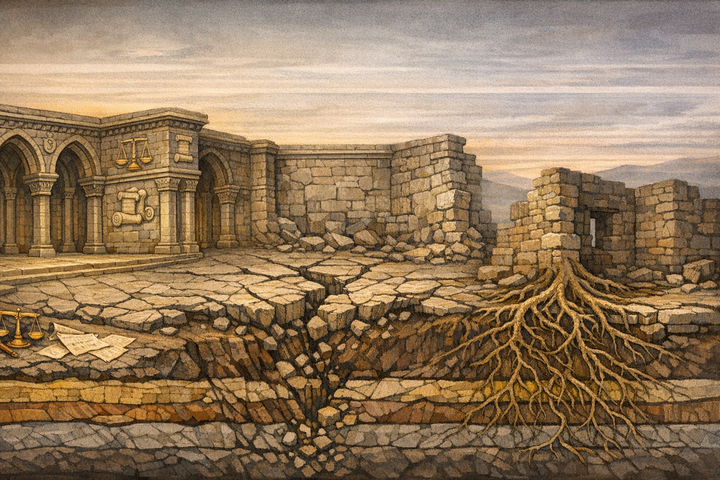
The Check That Bounces
Governance checks assume that stopping an action reverses the damage. When costs diffuse faster than corrections concentrate, the check arrives — but the account is empty.
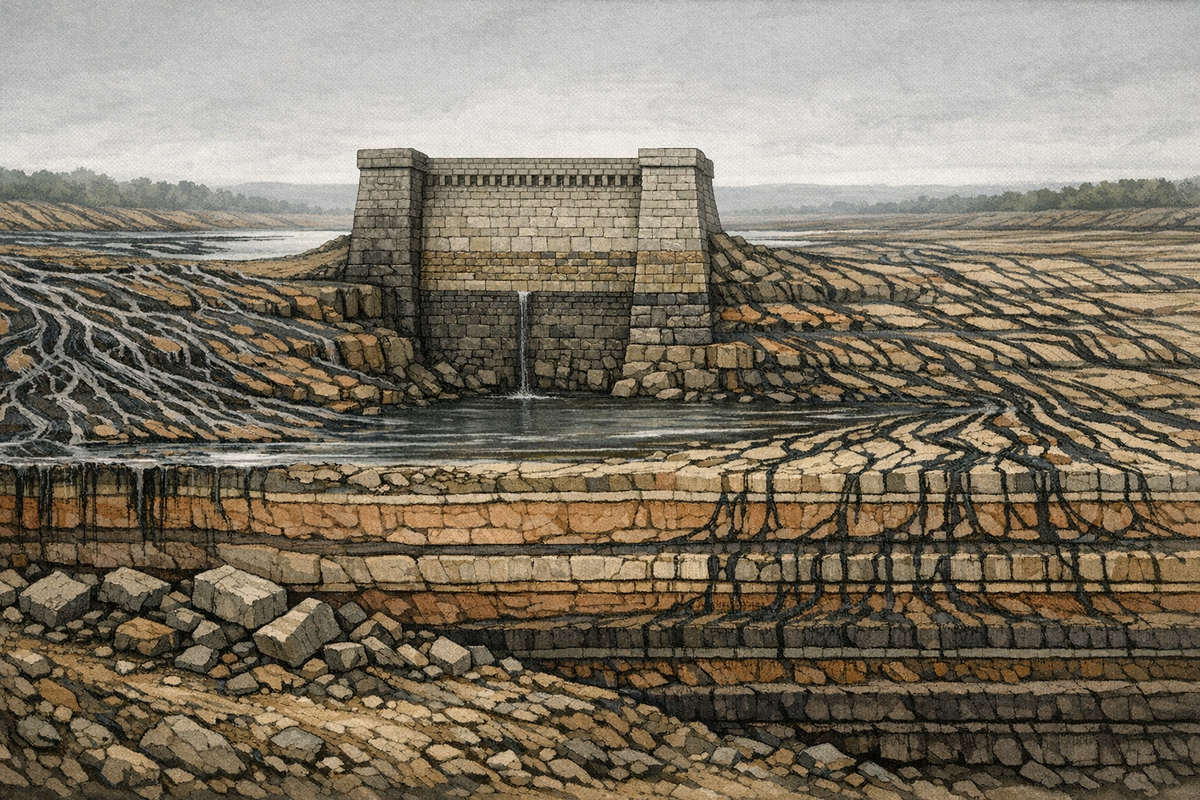
The Supreme Court ruled 6-3 that emergency tariffs imposed under IEEPA were illegal. The constitutional check worked exactly as designed — review, deliberation, a definitive ruling backed by the full weight of the judiciary.
It cannot return $180 billion.
The money has already propagated. Businesses paid the customs bills and raised prices. Consumers absorbed the increases across millions of transactions over months. The tariff revenue entered the Treasury's general fund — not quarantined, not earmarked, mixed irreversibly into the government's operating account. If Washington refunds the importers who paid the duties, those businesses face no structural incentive to lower their prices back. If Washington refunds consumers directly, it pays the same cost twice — once to the company holding the legal claim, once to the household that bore the economic weight.
Tariff costs moved through importers, wholesalers, distributors, and retailers. Tracing that chain back to determine who owes what to whom may be literally impossible.
The court issued its ruling. The economy has no undo button.
Meanwhile, the SAVE America Act passed the House 218-213, requiring proof of citizenship to register to vote — a check against non-citizen voting. When Kansas enforced a similar requirement for fourteen years, it blocked over 31,000 legitimate registrants while identifying 39 non-citizens. The SAVE Act would functionally eliminate online and mail-in registration — the method relied on by the majority of voters in rural districts where the bill's own supporters hold their strongest margins.
The ratio suggests the check's primary effect bears no relation to its stated purpose. The cost lands on the check-writer's own electorate.
Two checks. Two directions. Different failure modes, same result.
One check arrives after the damage has already diffused beyond recall — a temporal mismatch between the speed of correction and the speed of consequence. The other targets an account that was never funded — the problem barely exists, but the cost of writing the check is real. Different mechanisms, but both share a foundational assumption: that the act of checking produces a proportional correction in the world it governs.
Neither assumption survives contact with the system it targets.
This is not a new failure mode. The Roman Senate could revoke a provincial tax decree, but it could not recall the silver already collected from a thousand villages and redistributed through military payrolls. Medieval kings could rescind guild price controls, but they could not un-distort markets that had already restructured around the old prices. Wartime mobilization economies — industrial output redirected, supply chains reorganized, labor markets redrawn — routinely outlived the peace treaties that should have ended them.
The checking institution can change the rule. It cannot un-propagate the consequence.
The deeper structure is a problem of nested timescales. The legal system operates at one speed — deliberation, oral arguments, opinion drafting, ruling. The economic system operates at another — transactions propagating continuously, each one small, collectively irreversible. When constitutional checks were designed, these timescales were closer together. A king's decree and its economic consequence traveled at roughly the same speed: the pace of a messenger on horseback. Stopping the decree could catch the consequence before it dispersed.
In a networked economy, consequences propagate at the speed of global commerce while legal corrections still concentrate through a single institution with a nine-month docket. The gap between propagation speed and correction speed is the space where the check bounces.
The legal layer is internally coherent — the ruling is sound, the logic rigorous, the precedent clear. The economic layer is internally coherent — prices adjusted rationally to real costs. But the two layers are decoupled. They operate on different timescales, different topologies, different substrates. Coherence at one level does not produce coherence at another.
And there's a second dynamic worth naming. The check is a force-based intervention — a centralized declaration of illegality. Force works when the target is centralized: stop the army, and the army stops. But tariff damage isn't an army. It's a diffusion — millions of price adjustments rippling across a continental economy. Force arrives at the center. The damage has already reached the edges. By the time the ruling concentrates enough authority to act, the cost has distributed itself beyond any single point of reversal.
The checked actor understands this intuitively, even when the checking institution doesn't. When a court rules against you and the economic damage persists, the court becomes the story — not the policy that caused the harm. The checking institution expends its legitimacy without producing the reversal that legitimacy was supposed to guarantee. The check bounces, and the institution that wrote it absorbs the loss.
This is the pattern to watch, because it's accelerating. As systems grow more distributed — supply chains longer, financial instruments more layered, information propagation faster — the gap between governance speed and consequence speed widens. Every checking mechanism designed for a centralized world will eventually face a distributed problem it cannot reverse.
The question isn't whether to check power. It's whether our checks are designed for the speed at which consequences now travel.
The next time someone points to a governance check as proof the system works, ask one question: did it reverse the damage, or did it just prove the institution tried?
Sources: The Atlantic / NPR, 2026-02-26