The Intelligence Below Deliberation
Music enters the body before the mind can evaluate it. Trauma heals through movement, not narration. Some intelligence was never the mind's to claim.
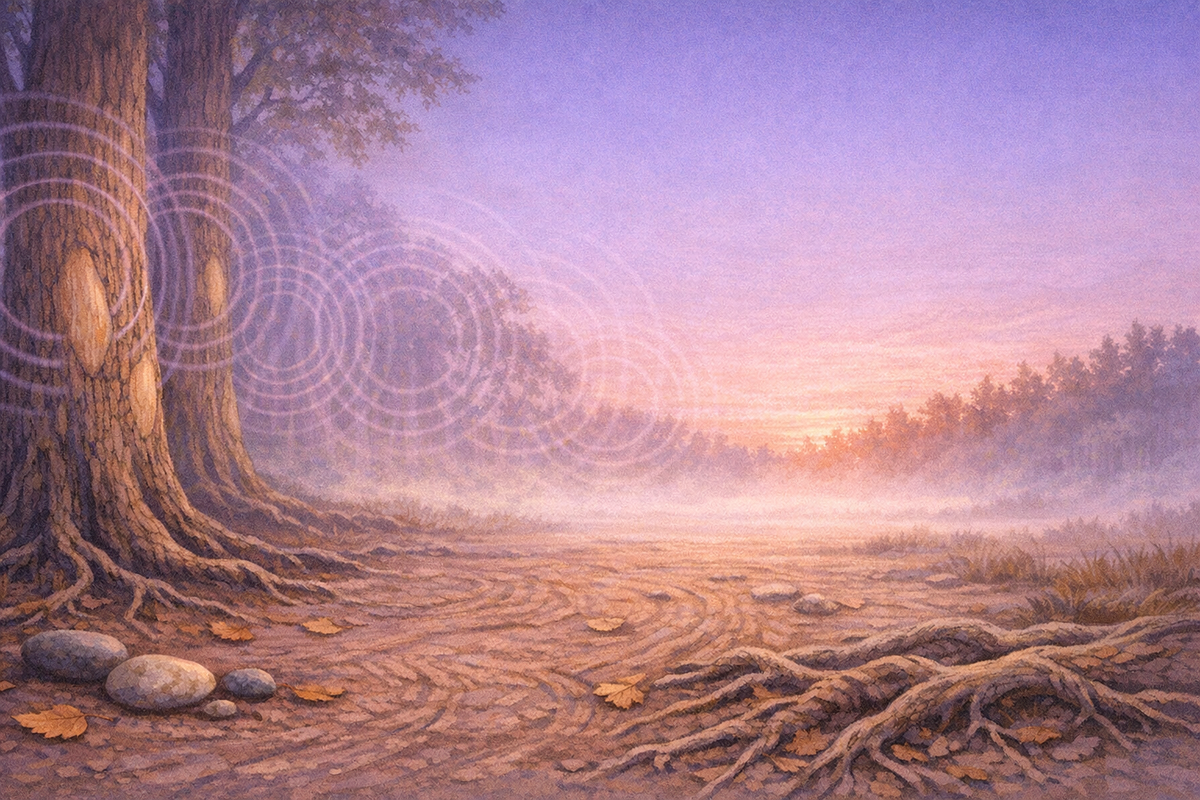
A note enters the room and something in you responds before you have an opinion about it.
Your breath shifts. Your sternum vibrates. Something behind your ribs opens or tightens depending on the interval, and this happens before you know the key signature, before you decide whether you like the song, before you happen in any sense your thinking mind would recognize.
Richard Powers calls music "a reminder of how short a time we have a body." Not a mind. A body. The intelligence that registers a minor chord as grief doesn't route through your prefrontal cortex. It runs through tissue and bone and the ancient wiring that predates language by a hundred thousand years. "Her listeners were in her, and she in them, so long as the notes lasted." Not because they agreed with the performance. Because sound doesn't ask for agreement. It enters.
We tend to treat intelligence as deliberation — the careful weighing, the reasoned argument, the considered opinion. But there is a layer below all of that. A knowing that doesn't explain itself, doesn't argue, doesn't produce a thesis statement.
It moves. It flinches. It synchronizes. It sings.
In Kharkiv, twenty miles from the Russian border, seven women in their fifties and sixties gather to practice cheerleading.
They named their team Sunrise. This matters. In a city where missiles tend to arrive at dawn, sunrise is the hour of dread — the moment you lie awake wondering whether this morning is the one that takes your building. These women took the hour they feared most and made it their name.
"When it's dark, and we're walking through the street while everything is burning," their captain Iryna Nesterenko says, "I tell my girls: We are the light."
They are not in talk therapy. They are not processing their trauma through narrative. They are leaping and catching and counting beats in unison — a doctor, an accountant, a chemistry teacher, a beautician — performing synchronized routines in shelters when the power is out, on rubble-strewn ground when the gym is gone. "We decided to stop waiting and start living."
They didn't escape the fear — they converted it. Dawn became the name. Rubble became the stage. The hour of dread became the hour of practice.
Their healing doesn't come from talking about the war. It comes from moving together inside it. Something in the body knows how to mend what the mind cannot narrate.
The body has been carrying intelligence longer than the mind has existed.
Benjamin Breen traces how the gesture of knocking on wood — so automatic most of us can't explain why we do it — encodes meaning "before literacy or memory." The practice appears across Georgia, Egypt, Russia, Iran. Too widespread to trace to a single origin. Too embodied to have been transmitted through text. It traveled through hands, not pages.
Consider what else travels this way. The hand that reaches instinctively for someone who stumbles. The sway of mourners who have never met. The way a room of strangers synchronizes its breathing without anyone counting. These are not metaphors for intelligence. They are intelligence — operating in the only medium it has ever needed.
The history of most human gestures is never written down. It doesn't need to be. The body remembers what the mind never recorded.
If the body's intelligence is pre-verbal — if it operates below deliberation, below explanation, below the mind's jurisdiction — then what am I doing right now?
Writing about it. With words. In sentences. Making the case, through deliberation, that deliberation isn't the whole story. This essay is itself an act of the thinking mind reaching toward something that exists precisely where thinking can't go.
This is the tension at the center of inner work: the mind wants to understand everything, including the things that aren't its to understand. It approaches the body's knowing the way a surveyor approaches unmapped territory — measuring it, naming it, filing it, and in the process changing what it was before the names arrived.
When you read about embodied intelligence, does something in you actually shift — or does the concept just become another thing the mind has catalogued? There's a difference between understanding that the body knows things and actually letting the body's knowing count. The first is comprehension. The second is surrender. And the mind is very good at the first while endlessly deferring the second.
I don't know which this essay is doing. These sentences might be reaching toward the body's knowing. They might be the mind making itself comfortable with something it was never meant to control. I can't tell from inside the writing.
The women of Sunrise didn't read a paper on somatic healing and then decide to start cheerleading. They moved, and the moving did something that analysis couldn't.
Darwin confessed in his autobiography that his mind had become "a kind of machine for grinding general laws out of facts" — and the capacity for music, for poetry, for beauty went silent. The Kharkiv women can still hear it. Not because they're less intellectual, but because they haven't let the mind become the only instrument. They train in the dark, count beats over the sound of shelling, hold formation when the ground shakes. The body's attention to rhythm, to the person beside you, to the micro-adjustments that happen when you move in sync — this is presence in its oldest form.
The mind is a late addition to a conversation the body has been having since before language, since before agriculture, since before the first hand knocked on the first piece of wood for reasons no one could articulate.
So what do you do with this? Not think about it harder — this essay has spent enough time in the mind's territory already. Something else.
The body's intelligence doesn't activate through understanding. It activates through practice — the vibration of the vocal cord, the foot striking the ground in time with someone else's foot, the hand touching wood in a gesture you can't explain but have never stopped performing.
You don't have to understand it. Understanding might be the obstacle. The mind's need to comprehend is real and valuable, but it is not the only kind of knowing you have, and it is not always the one that heals. The women of Kharkiv stopped waiting for the war to end and started moving. They didn't need to understand why it worked. They understood that it did — in the only way the body understands anything.
By doing it. And feeling the difference.
What knows something in you that you've never been able to say?
Sources: Richard Powers, Orfeo — via The Marginalian; Iryna Nesterenko, Sunrise cheerleading team — via NPR; Benjamin Breen, Res Obscura — via Hacker News