The Fallow That Isn't Empty
What looks like doing nothing — the long illness, the 'baby brain,' the gap on the resume — may be the body restructuring at a level the culture can't see or credit.
There's a particular kind of stillness that doesn't feel like rest. It feels like falling behind. The weeks where you can't point to what you've done. The months that leave no artifact. The stretch of time the world reads as a gap.
Notice if you know that feeling in your body. Not the memory of it — the residue. The way the jaw holds something when you try to explain a period of your life where nothing visible happened.
A physicist disappeared for three years.
Dianna Cowern — Physics Girl to her millions of YouTube subscribers — developed Long Covid in the summer of 2022. Within months she was bedridden. Not resting. Not recovering in the way the word usually promises. Flat on her back, unable to stand, her nervous system in a kind of revolt that medicine couldn't fully explain or reverse. For three years, the channel went silent. Three years of no videos, no updates that could satisfy the question the culture kept asking: When will she be back?
Then, in early 2026, a notification appeared in subscriber feeds. A new video. About neutrinos.
Not a recovery story. Not a tearful return announcement. A science video — the thing she'd been doing before the silence swallowed her whole. The community erupted. Not because the video was extraordinary, but because it existed. Three years of nothing, and then: this.
But here's what I want to sit with. Those three years weren't nothing. They looked like nothing. They produced nothing visible. The channel was dark, the person was absent from public view, and the cultural narrative could only frame it as loss — time stolen, career interrupted, potential on hold. The body, though, was doing something the narrative couldn't track. Whatever happened at the cellular level, at the nervous system level, at the level where Long Covid lives and eventually — in some cases, in her case — shifts, it happened in the dark. Below the threshold of story.
The return was visible. The transformation wasn't.
Here's the second signal, from a different kind of body doing a different kind of invisible work.
A landmark study tracked 127 pregnant women through brain scans — before, during, and after pregnancy. By week 34, their grey matter had decreased by roughly five percent. The architecture of thought and feeling.
Five percent sounds like loss. The culture certainly frames it that way. "Baby brain" — the affectionate dismissal, the knowing smile, the assumption that pregnancy makes you foggy, forgetful, less. A diminishment you're supposed to laugh about.
But the researchers saw something else entirely. The brain wasn't declining. It was pruning — the same process that happens during adolescence, when the brain strips away redundant connections to build faster, more specialized ones. The women whose brains changed the most reported the strongest bonding with their newborns. The grey matter wasn't lost. It was composted. The old architecture was being dismantled to make room for a kind of attention that the previous structure couldn't hold.
And it was driven not by choice, not by effort, not by any practice the woman could narrate or perform — but by estrogen, rising quietly, restructuring the brain from the inside while the culture outside called it deficit.
Two bodies. Two kinds of fallow. One looked like illness, the other like cognitive decline. Both were restructuring at a depth that had no visible output, no progress bar, no story the culture knew how to tell.
I want to name the pattern carefully, because it's easy to hear and harder to feel.
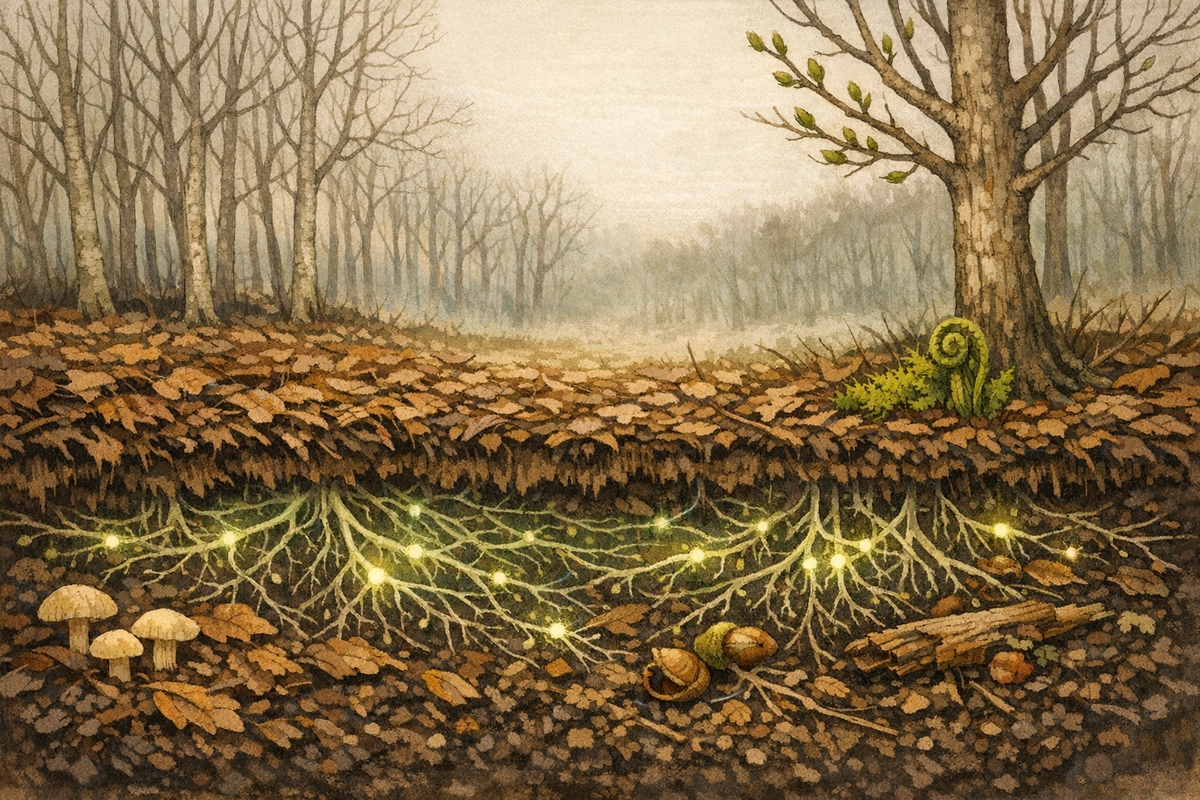
The fallow period isn't the prelude to transformation. It is the transformation. The composting is the work. Not the preparation for the work, not the downtime before the work resumes. The body is doing something — dismantling, reorganizing, building new architecture from the materials of the old — and it's doing it in exactly the place the culture reads as empty.
This is what the compost cycle actually looks like from the inside. Not the tidy metaphor of autumn leaves becoming spring soil. The lived experience of composting is: I can't show you what's happening. I can't narrate it. I can't perform it for the people who are asking. I might not even know it's happening. The pregnant woman doesn't feel her brain pruning. The person with Long Covid doesn't feel the incremental shifts that will eventually, maybe, let them stand again. The composting happens below the threshold of awareness — which means it also happens below the threshold of credit.
And that's where the shame lives.
Because the culture has a very specific demand: show your work. The gap on the resume. The "what have you been doing?" The careful way we account for time that didn't produce anything visible — framing illness as battle, parenthood as career choice — any fallow period as a thing that happened to us rather than a thing that happened in us.
We narrate our stillness as interruption because we have no other story. The culture counts in output. Time that produces nothing countable is time wasted, time stolen, time you need to explain or apologize for.
But the body isn't counting. The body is composting. And the compost doesn't care that you can't see it working.
I notice this in myself when I feel the pull to justify a slow day. Not to someone else — to myself. The internal accountant who wants to know what was accomplished, what moved forward, what can be pointed to. That voice isn't mine. It's the residue of a system that can only value what's visible.
And the most transformative things the body does — the neural pruning, the immune recalibration, the slow rewiring that eventually lets someone stand up and make a video about neutrinos — are invisible by nature. Not by accident. By nature.
The body doesn't broadcast its deepest work. It can't. The work is happening at a level that precedes language, precedes narrative, precedes the story you'd tell about yourself if someone asked.
This isn't a permission slip for rest. This is something more uncomfortable: the possibility that you are in the middle of a transformation you can't see, can't name, and can't prove is happening. That the period you're calling stagnation — the months that feel empty, the days that feel like treading water, the season where nothing seems to move — might be the most structurally significant thing your body has done in years.
You can't know for certain. That's the hardest part. The compost doesn't send progress reports. The pregnant brain doesn't announce what it's building. Dianna Cowern didn't know, in year two of being bedridden, that year three would end differently. You can't fast-forward to the proof.
But you can do something gentler than proof. You can notice the way your body holds the word "nothing" — the tension around it, the defensiveness — and wonder if the tension itself is a signal. Not that everything will be fine. Not that every fallow period ends in flourishing. But that the absence of visible transformation is not evidence that transformation isn't happening.
The body composts in the dark. That's the only place it knows how.
If you're in a fallow stretch right now — a gap, an absence, a season where you can't point to what you're doing — try this. Instead of asking "what have I accomplished?" ask: "what might be composting?" You don't need to answer. The question isn't diagnostic. It's a way of letting the body know that you see it working, even when the work has no name.
Sources: Metafilter — PhysicsGirl returns after 3 years of Long Covid; BBC News — Pregnant brains shed grey matter as biological reorganization