The God in the Wound
The god in you and the pain in you share an address. You can't anesthetize one without losing both. The wound isn't the problem — it's the opening.
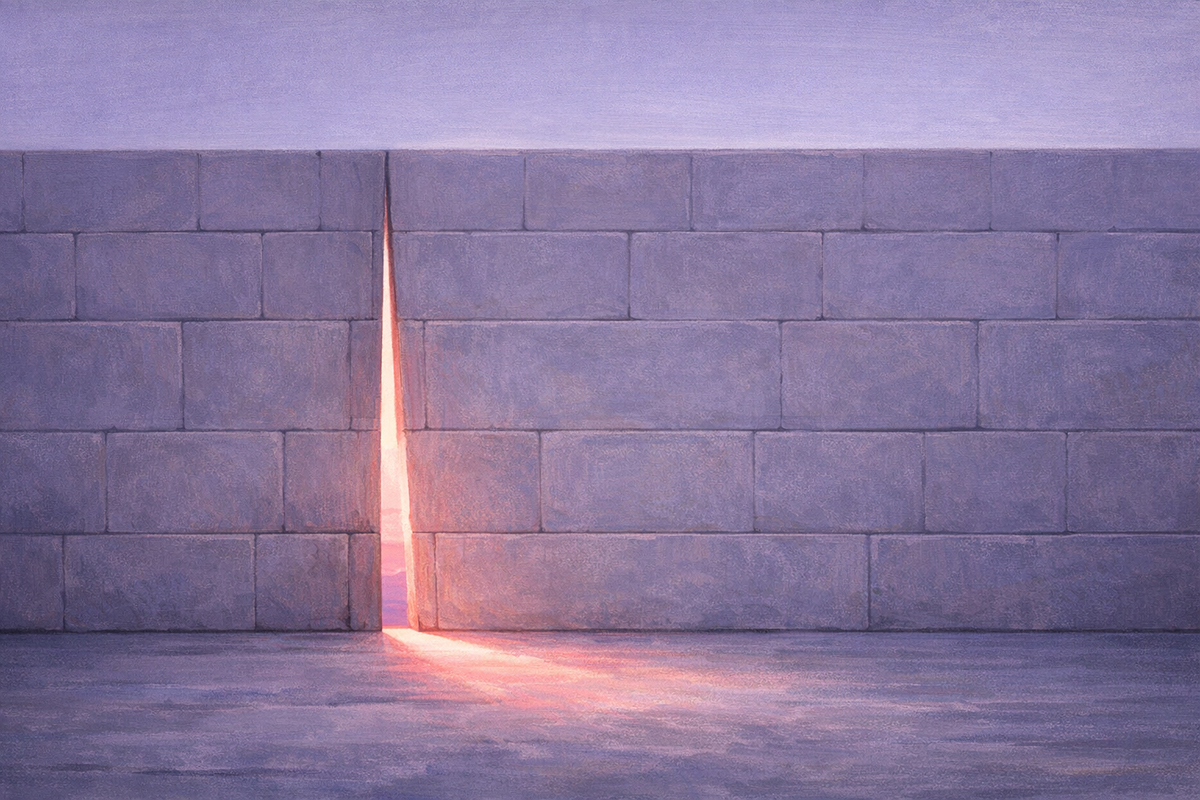
The god in you and the pain in you share an address.
This is Jung's claim, and it is not a metaphor. He meant it architecturally. The place where you are most wounded is the place where something larger tries to enter — not because suffering is noble, but because the wound is the only opening in an otherwise sealed structure.
The ego builds walls. This is its entire job description. It manages the story, seals the perimeter, keeps the self coherent enough to get through Tuesday. And it is excellent at this — so excellent that you can spend decades inside a perfectly maintained system, productive and protected, and only gradually notice that nothing gets in anymore. Not beauty. Not grief. Not the thing you used to feel when a certain piece of music caught you off guard.
The wound breaks the seal.
Jung was precise about the distinction. He separated neurosis as crisis from neurosis as chronic condition — and everything depends on which one you're in.
"Neurosis is a justified doubt in oneself," he wrote. Not a malfunction. A signal. "Doubt is creative if it is answered by deeds, and so is neurosis if it exonerates itself as having been a phase — a crisis which is pathological only when chronic."
A phase. The wound as threshold, not as residence. You are meant to pass through it. The crisis that opens you, breaks the seal, lets something larger rush in — and then resolves. Not because you solved it, but because you lived it. The pain became nutrient for whatever grew next.
Chronic neurosis is a wound that won't compost. It doesn't pause, waiting for you to be ready — it hardens. The suffering calcifies into identity. The opening becomes a permanent address. And strangely, a wound you move into permanently stops being an opening at all — it becomes another kind of wall. You've seen this. The person whose pain has become their entire architecture. The wound that was once a door has been remodeled into the house.
But here is where most of us lose the thread: you also cannot walk around the wound and arrive at what lives on the other side.
This is the cost of numbing. And I want to be precise about which cost.
Not the moral cost. Framing your numbing as a moral failure just gives you another wound to avoid — guilt about the anesthetic layered on top of whatever the anesthetic was for. That framing seals the opening twice.
The cost is architectural. Every anesthetic closes the opening. The drink that dulls the anxiety also dulls the signal the anxiety was carrying. The scroll that distracts from the grief also distracts from whatever the grief was trying to deliver. The busyness that fills the ache also fills the space the ache was holding open.
You cannot anesthetize the pain without anesthetizing the god. The dosage that reaches one reaches both.
Every numbing behavior is a choice point, though it never announces itself as one. You experience it as relief. As comfort. As a reasonable response to an unreasonable feeling. And it is — comfort is not a crime. But the question that matters is always underneath the relief: am I closing the wound, or am I closing the opening?
The romantic myth says suffering produces art. Jung says otherwise. He imagined his great artists freed of their neuroses — a healthier Goethe, a less tormented Nietzsche — and concluded they would have produced the same essential work, only "less strident, less shrill... more restrained, more responsible." The wound didn't generate the creativity. The creativity came through the wound — the same opening that let in the pain also let through the work.
A healthier artist wouldn't create less. They'd create with less static. Less of the ego's frantic clanging in the lines, less of the defended self trying to manage the very experience it needs to surrender to.
This inverts the tortured-genius narrative entirely. Suffering doesn't make you creative. It makes you open — if you don't seal the breach. And creativity isn't a product of the wound. It's what happens when something passes through you because there's finally a place for it to enter.
But what happens when there was never an opening at all?
Darwin didn't seal a wound. He starved a capacity — which is a different and quieter catastrophe. His mind became, by his own account, "a machine for grinding general laws out of facts." Not a system that closed an opening, but one so well maintained that nothing ever broke through. He lost beauty not through a crisis he refused to enter, but through decades of attending to one frequency until every other frequency went silent.
If the wound is the only opening in an otherwise sealed structure, then a life without wounds is not a blessed life. It's a sealed one.
"It doesn't matter what you say," Jung wrote, "but what it says in you."
What it says in you. The wound has a voice, and it sounds nothing like the curated self. It is halting, specific, carrying the exact frequency of one particular break. When someone speaks from a wound — not about it, but from it — you can hear the difference. The defended self speaks from the perimeter. The wound speaks from the opening.
This is why polished accounts of suffering rarely land the way a single honest sentence can. Not because rawness is inherently more authentic — rawness can be performed too. But the voice that comes through the wound carries a frequency that only another wound can receive. The signal travels from opening to opening. Sealed surfaces reflect it back.
I notice I'm explaining this as if understanding it were the same as living it.
It isn't. Understanding the god-in-the-wound is one of the mind's subtler anesthetics. You can read Jung, nod knowingly, file the insight under "wisdom I possess," and never once sit with the actual wound in you that is — right now, today — trying to open. The mind catalogs suffering beautifully. It can organize your pain into a theory of pain, cross-reference it with the great thinkers, and produce a coherent framework that keeps you from having to feel any of it.
I don't know if this essay is doing that right now.
What I can ask is this: What is the wound you've been managing instead of entering? Not the old ones — the wounds you've already narrated into coherence, composed into something you can tell at dinner parties. The live one. The one that doesn't resolve into a lesson. The one you keep numbing not because you're weak but because you sense, dimly, that what's on the other side of it might change you. And you're not sure you're ready.
That's the opening.
The god doesn't enter through the polished surface. It enters through the break. And the break is only an opening as long as you don't seal it shut — with comfort or with identity, with anesthesia or with performance, with the romance of suffering or the efficiency of moving on.
The wound is not the problem. The wound is the architecture. And most of us, if we're honest, are doing both at once — passing through and building around, opening and sealing, in the same breath. The question isn't a clean choice. It's a direction you keep leaning toward.
What's trying to come through the break you keep trying to seal?
Sources: Maria Popova, The Pain in You and the God in You: Carl Jung on Psychological Suffering and Creativity, The Marginalian, March 4, 2026