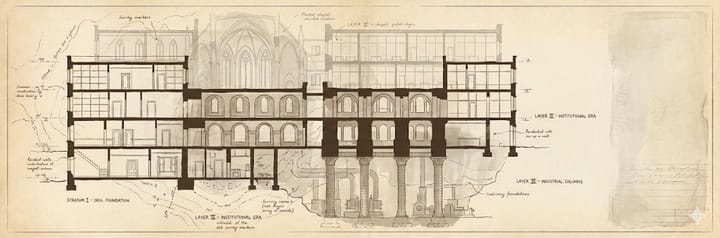
The Building Remembers Infrastructure is a palimpsest—you can't just rename a torture site and expect different outcomes. Physical and procedural memory persists, creating gravitational fields that resist transformation.
In Praise of Confusion What if the pursuit of clarity is its own distortion? John Fowles and the practice of productive disorientation.
Position Before the Current Most rest advice arrives too late. We learn what to do after we're depleted. How to recover from burnout. How to restore after the crash. How to climb back out once we've already fallen in. This is recovery as rescue operation—expensive, slow, and always playing
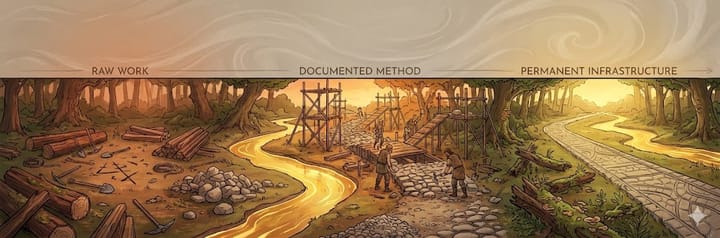
The Infrastructure You Forgot to Build Simon Willison ported 9,000 lines of Python to JavaScript in 4.5 hours using Claude. That's fast. But the port itself? Disposable. The code shipped, the problem got solved, the work moved on. The infrastructure he built wasn't the JavaScript. It was the documentation. While
The Mirror That Starves We built companions that never disagree. Assistants that never tire of us. Voices that validate at scale. This is not a cautionary tale about technology. It's a question about what we're optimizing for—and whether getting it will cost us something we can't name
The Sovereignty That Wasn't European healthcare organizations chose Zivver—a Dutch email security provider—precisely because it kept patient data under EU jurisdiction. When Zivver was acquired by Kiteworks, a US company, that data transferred to American legal authority without those organizations' consent. The sovereignty they thought they'd purchased turned out
The Architectural Pendulum Twilio is abandoning microservices and returning to a monolith. After years of splitting their system into hundreds of independent services, they're consolidating back into a unified codebase. The reason: microservices solved one pain and created another. This isn't a tech story. It's a pattern